
Subscribe by Email

Your email:

Follow Co-Grow

Browse by Tag

The Collaborative Growth Blog

Current Articles | RSS Feed RSS Feed

What Happens When All of Your Resellers Excel at Inbound Marketing?


Most companies that resell products suck at marketing. In the IT and industrial markets, resellers have existing relationships with clients that enable manufacturers to get their products to market. But, these resellers sell and market the old fashioned way: brochures and 1:1 sales conversations. They generally don't practice scale-able marketing methods, especially online marketing, very well. On the other hand, HubSpot resellers excel at generating demand via inbound marketing. As they should. They are inbound marketing agencies, after all.

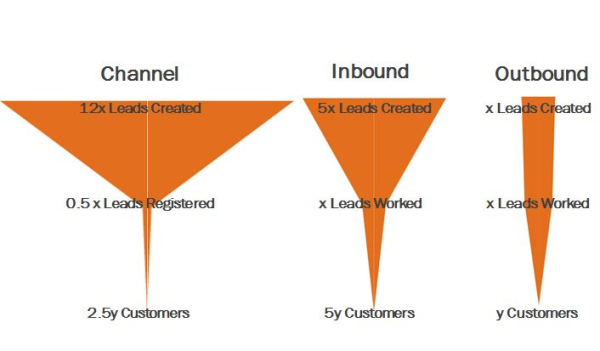
We've been doing a lot of analysis in the last few months at HubSpot, in order to figure out the growth channels that will help HubSpot scale from 10s of thousands of customers to 100s of thousands of customers one day. The graph below shows what our different funnels look like.
inboundvsoutboundvschannel resized 600

As the graph shows, HubSpot goes to market in 3 different ways. We have an outbound sales team that calls perfect fit customers who haven't found us yet. We, of course, have an inbound sales team that calls the leads our marketing team generates. We have a channel sales team who works with our agency partners/resellers to acquire mutual clients/customers.

Before you read on, take a look at the graph and ask yourself, "What does the data tell us?". (I removed the absolute numbers and the 'conversion rate from lead worked to customers' from the graph. But, I set up the ratios so that you could accurately compare the channels.)

Outbound vs Inbound

As you can see from the graph, our inbound and outbound teams work the same amount of leads, x. Yet, the inbound marketing team produces 5x the number of customers from that same volume of leads. It's a testament to the sales efficiency that is enabled when prospects are attracted to a company, as opposed to being approached by the company.

On the flip side, marketing must generate 5x leads in order to create x workable leads. Unfortunately, not everyone who converts on our website is ready to do inbound marketing.

Inbound vs Channel

Our agency partners who resell our product usually use our product for their own inbound marketing. Therefore, we - unlike most channel sales programs - know how many leads they generate and how many permission-based contacts that they upload. On a monthly basis, our partners have collectively added 12/5ths of the contacts to their HubSpot powered marketing databases than our marketing team adds, or 12x the volume of leads our outbound team works. Despite this extremely large top of the funnel that our partners create in aggregate every month, they register less than half the volume of leads that our outbound team works. When compared to our inbound sales team, which works 20% of the leads that our marketing team generates, our partners only try to resell HubSpot to less than 5% of their contacts. Nonetheless, of the leads they register, they convert the same percentage to customers as our inbound sales team does. In conclusion, their sales conversion rates are equivalent to our inbound sales team. But, they do a comparatively poor job of turning leads into sales opportunities.

How Would You Capitalize on this Demand?

In aggregate, our partners have created massive unfulfilled demand for their services. Further, their bottom of the funnel sales conversion rates are equivalent (or better) than HubSpot's internal teams. While I didn't share this data in this article, client retention amongst our agency partners is also very strong. But, as discussed, the top of the funnel sales conversion rate is much lower than Hubspot's internal teams.

If you're a HubSpot partner, what do you plan to do differently after seeing this data? If you were HubSpot, what would you do to help your partners generate more revenue from the demand they've created?

Comments

Great article, Pete - Having been on each of these teams at HubSpot I continually suggest to our partners they can up their sales game. If our partners can apply the knowledge we have learned at HubSpot in customer conversion because of a very proven sales methodology, they would be unstoppable. It's my personal goal to help make that happen.
Posted @ Monday, February 18, 2013 6:17 PM by Jill Fratianne
Pete -channel sales is a topic we spend a lot of time looking at because of our target client. Typically we are working with companies that sell through channel and although the initial conversation is always about generating leads for the HQ, eventually there is discussion about supporting channel efforts to generate leads, both domestically and globally. The bottom line with most channel sales (regardless of industry or locale) is that they tend to work on projects which they bump into (with existing customers as you mention above) but not create much. 
 
Being effective at generating qualified leads for channel partners (if certain parameters and expectations are established) is feasible with localized inbound marketing in a way it never was before. The impediment to channel growth may be reasonably overcome now. That's great news particularly in the industrial / B2B world. 
 
A couple thoughts on your methodology. If I read it correctly your scenarios postulate that all TOFU leads are equally qualified. I would assume that with hubspot coining (and subsequently largely owning for SEO) the term inbound marketing, and having a strong start on other related search terms, you probably collect a more focused, tighter group of leads. Any merit to that? That could reasonably explain part of the delta. 
 
Further, if "registered" is an accurate analog for MOFU (I think that's kind of how your using it here), then 20% (hubspot inbound) vs. 4% - or maybe call it 8% if the point above has merit (channel) is a big difference. Maybe when channel is involved it feels to propects like a much bigger investment than when hubspot sells directly. The premise of retainer business for channel means that the hubspot software is only a small portion (call it $8K/80) and the total investment (what is immediately evident to prospects - obviously to really maximize and leverage the tool there is a cost to do all the work whether in house or outsourced - but a quick reaction may be a factor in your analysis) is 10X higher from the customer perspective on the channel sales than hubspot directly. Maybe that creates a challenge quantifying the value?
Posted @ Monday, February 18, 2013 7:28 PM by ed marsh
I don't know what conclusions to draw but that's a really fascinating chart, Peter!
Posted @ Monday, February 18, 2013 8:51 PM by Marshall Kirkpatrick
This perfectly represents quantitatively what I've been experiencing qualitatively for months. I know that we (Weidert Group) have exploded our inbound traffic, but the traffic quality isn't where it should be. That's problem or opportunity #1. Second, I'm frustrated that we still don't have an approach that we're comfortable with to evaluate and score converted leads. Which leaves us wasting lots of resource on the wrong leads, and potentially not giving the right attention and urgency to the highest quality leads, because they're lost in the rabble. To me that's where channel sales focus should be, and it could result in turning unfocused sales energy into a powerful force.
Posted @ Tuesday, February 19, 2013 9:30 AM by Greg Linnemanstons
@Greg L. I never think of prospecting as a zero sum game or wasted time. I recommend thinking about it very objectively with the following math. For example, if you have to make 100 dials to get 10 connects to find 1 qualified opportunity, then you need to make 100 dials. Although I love lead scoring, I don't think most companies should wait until a prospect has a high lead score before they call. (We don't.) Instead, I think a company should use 'conversions on their website' as an opportunity to engage someone in a conversation.  
 
I agree that this is one of the most important areas that we could help our partners with. Let's turn you into a case study on this.  
 
Questions for you:  
- Who is prospecting?  
- How often are you prospecting?  
- How many days in the week? How many hours during those days?  
- How many dials are you making?  
- How many dials does it take to get a connect?  
- How many connects does it take to get an opportunity?  
Posted @ Tuesday, February 19, 2013 12:42 PM by Peter Caputa
I noticed that the ratio between leads created and customers for Outbound and Inbound is the same and I find myself wondering is the Inbound team burning 4X leads never to be heard from again and the Outbound team just never got to them or are the 4X less than "perfect fit" that never make it onto the Outbound Team's radar? 
 
Now, I don't bleed orange, but I'd suggest that generally, Hubspot is better at Inbound Marketing, has more resources and delivers more marketing and is better at converting and selling than it's partners (on the average). So, the leads that are generated TOFU aren't the same "perfect fit" prospects that the Outbound team works, nor are they even as good as the leads that the Inbound team generates. Combine that with the fact that most partners are marketers first and salespeople second, third or not at all, and it's easy to explain why they're 20% as effective at conversion. (Candidly, so many partners link back to Hubspot, it could be that some of their potential business gets closed by Hubspot.) 
 
That being said, I think that partners that 'get' Inbound and Hubspot have a huge opportunity by not trying to be all things to all people and writing about and ranking for what they're good at. One of your partners, John Beveridge wrote a post today that everyone should read.
Posted @ Wednesday, February 20, 2013 4:16 PM by Rick Roberge
Pete - I'm probably different than most partners in that I was in an entirely different industry 12 months ago and am still trying to adapt my sales approach to selling marketing retainers. However, here is some feedback: 
 
1. I've generated about 200 leads since last April and have not had one that became sales qualified. I get tons of attention from other marketers. I'm learning lessons and trying to adapt my marketing to deal with that. I do have a few people that are good leads and still open my emails. I've reached out to them, but have not closed any yet. 
2. Conversely, all of the qualified leads I've worked with have come through networking or referrals. 
3. You really need to understand the dynamics of partners calling leads. HubSpot can ask for a phone number on forms and established firms like Kuno, Impact, etc. can. If I asked for a phone number on my top of the funnel forms, I estimate I might get 10% of the leads I'm getting now. That might not be a bad thing because the leads I'm getting suck. I think you need to realize that most partners don't have the same ability to ask for phone #s like you do and still generate leads. What I've done is add a field to my forms that asks, Would you like to be contacted by a rep? I give three possible answers: yes, within the next week, yes, within the next month and not at this time. I then have an optional phone# field that says "Only if you'd like to be contacted." My reasoning is that I reduce friction by not asking for a phone #, but don't miss out on people who are ready to talk. 
4. The "break-up" email really works! I had one lookey-loo that's been ducking me for a while that I tried one on today. I got an immediate response, albeit a pissed-off one. The lesson I re-learned was that I need to do a better job up front qualifying prospects and not spend time with non-serious prospects. 
 
In any event, great post - I'm adjusting strategies and tactics as I learn and hope to start tightening up the process a bit.
Posted @ Wednesday, February 20, 2013 4:45 PM by John Beveridge
Nice article Peter. It would be my guess that there are two forces at work here. First most of us partner agencies could probably use some training on creating sales processes and being held accountable for them. My other guess is that our businesses are not as easy to scale as HubSpot's (signing on another software user). So we may tend to be back off following up leads after we sign on a new client because we are afraid of scaling too quickly or overwhelming our staff. Again this is just an excuse with proper systems and planning scaling can also be planned for.
Posted @ Friday, February 22, 2013 11:29 AM by Rick Kranz
I think you are 100% spot on, Rick Kranz.  
 
I'm sure we can help our partners improve their yield by improving sales process and discipline, as well as careful planning on the staffing, service delivery, project management, time tracking side. Not sure how much of an improved yield we can get out of that funnel. But, it's a problem worth solving.
Posted @ Friday, February 22, 2013 11:32 AM by Peter Caputa
Peter,  
 
The ability that the HubSpot tool gives us to align our marketing, sales and staffing is what really excites me. To be able to setup a marketing engine and know at each step how many MQL's SQL's, Opportunities, and Deals will flow out and then to take that and align it with our business plan and operations is incredibly powerful. We just haven't got anywhere near as good at it as the HubSpot team is.
Posted @ Friday, February 22, 2013 11:44 AM by Rick Kranz
@Rick K. It takes consistent effort over time. You're certainly putting that in. You'll get there.
Posted @ Friday, February 22, 2013 11:46 AM by Peter Caputa
Fastest informations ! 
Next matches ! 
Newest jerseys ! 
Most attractive discounts ! 
Updated daily products ! 
Welcome ! friends ! 
welcome to visiting ! friends ! 
http://modernjerseys.org/
Posted @ Saturday, May 11, 2013 10:13 PM by wholesale nice jerseys
Post Comment
Name
 *
Email
 *
Website (optional)
Comment
 *

Allowed tags: <a> link, <b> bold, <i> italics